A very interesting study confirming previous reports on the possibility of using low doses of bevacizumab. A dose of 1 mg / kg / 2 weeks looks very strange. However, to the surprise, the authors report a similar effect with other doses and less toxicity! Your opinion?
METHODS:
From September 2013 to August 2016, we recruited patients with progressive glioblastoma, whatever the previous treatments. We compared a routine control group (CG) of ten mg/kg, to a low dose group (LDG) composed of 5 subgroups: G5: five mg/kg, G4: four mg/kg, G3: three mg/kg, G2: two mg/kg, G1: one mg/kg; each patient was treated with the same dose every two weeks.
RESULTS:
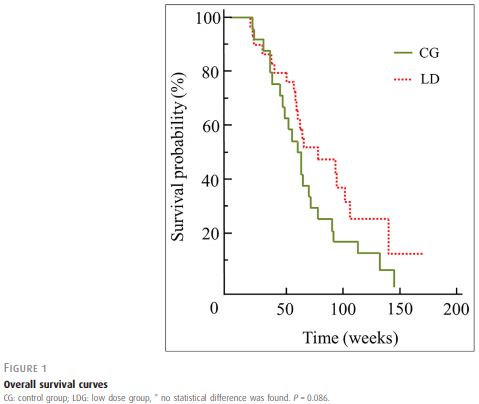
Fifty-three patients were treated: 20 women and 33 men, 24 in the CG and 29 in the LDG. The median age at diagnosis was 62 years [35.0-77.0]. No statistical difference was found in overall survival either for the CG or the LDG (P=0.086) or among groups (P=0.251), with even a trend toward improvement for LDG: 62 weeks [20-145] versus 73 weeks [18-178]. The median progression free survival was comparable: 19.5 weeks [6.0-54.0] for the CG and 15.0 weeks [0.0-134.0] for the LDG (P=0.221). Bevacizumab was stopped either due to progression (45.1%) or toxicity (52.9%), without significant differences between doses but maybe less toxicities in the LDG (16.7% for toxicity in G1).
DISCUSSION:
Use of bevacizumab at progression at lower than usual doses seems to give the same results as the standard dose without giving additional toxicity.