Hi all,
My mom's Caris report showed ATM mutation with "variant frequency" of 52% (EGFR was 59% and PTEN was 17%). Her doctor is suggesting HDAC drug/belinostat trial. Has anyone seen ATM mutation on their genetic report? Is it common in GBM? We may switch her from Keppra to valproic acid as it is also a HDAC drug, or give her both. Thank you for your help!
Showing posts with label Caris_Molecular_Intelligence. Show all posts
Showing posts with label Caris_Molecular_Intelligence. Show all posts
Monday, 17 December 2018

Thursday, 10 May 2018
Tumor Mutational Burden and response to immunotherapy
Tumor Mutational Burden as an Independent Predictor of Response to Immunotherapy in Diverse Cancers.
https://www.ncbi.nlm.nih.gov/pubmed/28835386
This study was a collaboration between UC San Diego, and Foundation Medicine.
Response rate, progression-free survival and overall survival following immunotherapies (in general, or specifically for immune checkpoint inhibitors such as anti-PD-1/PD-L1) was increased in patients with higher tumor mutational burden (as determined by genetic sequencing).
My commentary:
Newly diagnosed gliomas including GBM usually have low tumor mutational burden. At highest risk for high tumor mutational burden (hypermutation) are likely those with MGMT-methylated tumors that recur following standard TMZ chemotherapy.
Pembrolizumab (Keytruda) is approved by the United States FDA, among other indications, "for the treatment of adult and pediatric patients with unresectable or metastatic, microsatellite instability-high (MSI-H) or mismatch repair deficient solid tumors that have progressed following prior treatment and who have no satisfactory alternative treatment options. "
The very high mutational burden sometimes seen in recurrent gliomas following temozolomide chemotherapy is often caused by mutations in one or more of the mismatch repair genes (MHS2, MSH6, MLH1, PMS2). Having genetic sequencing performed (in North America by Foundation Medicine or Caris, or different companies in other countries) for recurrent post-temozolomide grade IV tumors (especially MGMT methylated tumors) could be a worthwhile way to detect hypermutation/mismatch repair deficiency/microsatellite instability and get access to pembrolizumab outside of a trial. I can't comment on how easy getting coverage would be (both for the genetic testing as well as the pembrolizumab), as it would in part depend on the policies of the various insurance providers.
https://www.ncbi.nlm.nih.gov/pubmed/28835386
This study was a collaboration between UC San Diego, and Foundation Medicine.
Response rate, progression-free survival and overall survival following immunotherapies (in general, or specifically for immune checkpoint inhibitors such as anti-PD-1/PD-L1) was increased in patients with higher tumor mutational burden (as determined by genetic sequencing).
My commentary:
Newly diagnosed gliomas including GBM usually have low tumor mutational burden. At highest risk for high tumor mutational burden (hypermutation) are likely those with MGMT-methylated tumors that recur following standard TMZ chemotherapy.
Pembrolizumab (Keytruda) is approved by the United States FDA, among other indications, "for the treatment of adult and pediatric patients with unresectable or metastatic, microsatellite instability-high (MSI-H) or mismatch repair deficient solid tumors that have progressed following prior treatment and who have no satisfactory alternative treatment options. "
The very high mutational burden sometimes seen in recurrent gliomas following temozolomide chemotherapy is often caused by mutations in one or more of the mismatch repair genes (MHS2, MSH6, MLH1, PMS2). Having genetic sequencing performed (in North America by Foundation Medicine or Caris, or different companies in other countries) for recurrent post-temozolomide grade IV tumors (especially MGMT methylated tumors) could be a worthwhile way to detect hypermutation/mismatch repair deficiency/microsatellite instability and get access to pembrolizumab outside of a trial. I can't comment on how easy getting coverage would be (both for the genetic testing as well as the pembrolizumab), as it would in part depend on the policies of the various insurance providers.
Thursday, 22 March 2018
Should we get the NGS done? If yes, from where?
Hi folks/Stephen,
Needed a bit of help from you all. My mom is a GBM patient who was diagnosed in Sep 2017. Her cancer is IDH1/2 -ve, methylated and 1p/19q codeletion negative, this is the information that we gauged from the initial gene testing that was done by our hospital post surgery. We are now considering a next generation gene sequencing test done, and I had the following questions on the same:
1. How helpful has the gene sequencing report been for you so far, if you have got one done? What questions should I look at getting answered from this test?
2. Since there is very little tumor tissue that we all have, which is the best place to get the gene sequencing done from? I currently have read and spoken to OncoDNA, StrandAdvantage, RGCC Greece and FoundationOne so far. Which one would you recommend, and why? The recommendation could be different from the mentioned five too.
I read the following doc shared by Stephen in the Brain Tumor library too, but I'm not quite able to figure out on which test is a more appropriate one for what kind of patient.
https://docs.google.com/spreadsheets/d/1653spmu9DkVCKX16G0_ZUlsTuJOx_Ln2qVysJJI-uoU/edit#gid=0
There are so many genes written in all of them, that it's hard for me to be able to compare and make an informed call :/
Want to know if the gene testing will be of help in further treatment, and the drugs/supplements that we should use for her in the near future.
Her current status
1. Her MRI three months back showed no growth, but had choline elevation at two parts where there was tumor resection. We have her next MRI in about a week from now.
2. She will do her remaining chemotherapy cycles with Temozolomide+Lomustine, her cancer being methylated.
She currently is on ketogenic diet and lot of naturopathic supplements suggested by Nutrition Solutions.
My plan going forward
After my mom is done with the chemotherapy, I plan to get her immunotherapy (Dendritic cell therapy) done. Want to know if the gene sequencing will be an add on in this plan.
Monday, 8 January 2018
Predicting immunotherapy response
1. The company OncoDNA provides test OncoDeep: 70 genes + predicting immunotherapy response.
https://www.oncodna.com/en/immunotherapy/
Price: 2990Eur.
Are there any studies predict immune therapy in other laboratories? Is this study useful?
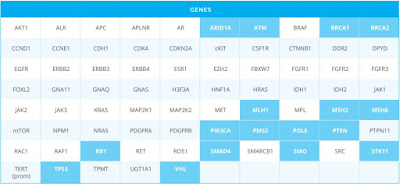


3. Here (https://www.cegat.de/en/diagnostics/tumor-diagnostics/ovarian-cancer/) it is reported that "The detection of a somatic or germline mutation in the BRCA1 or BRCA2 genes is a requirement for treatment with Olaparib (LynparzaTM)"
There are also 4 testing options.
"Option 1: BRCA1 and BRCA2 analysis in tumor tissue only
In option 1, only mutations in the tumor are analyzed, no differentiation between germline and somatic mutations can be made. We do not recommend this option, but will perform it when it is explicitly requested by a patient."
Is it necessary to do such a study to determine the possibility of treatment with Olaparib or is it enough to study Oncodeep (by OncoDNA)? But in Oncodeep only mutations in the tumor are analyzed.
Option 1: BRCA1 and BRCA2 analysis in tumor tissue only
 Option 4: Somatic Tumor Panel

https://www.oncodna.com/en/immunotherapy/
Price: 2990Eur.
Are there any studies predict immune therapy in other laboratories? Is this study useful?


2. By the way, in Moscow (Russia) a study of 50 genes costs $480. Can this research give some useful information? Or these 50 genes is very limited and such information is not sufficient?

3. Here (https://www.cegat.de/en/diagnostics/tumor-diagnostics/ovarian-cancer/) it is reported that "The detection of a somatic or germline mutation in the BRCA1 or BRCA2 genes is a requirement for treatment with Olaparib (LynparzaTM)"
There are also 4 testing options.
"Option 1: BRCA1 and BRCA2 analysis in tumor tissue only
In option 1, only mutations in the tumor are analyzed, no differentiation between germline and somatic mutations can be made. We do not recommend this option, but will perform it when it is explicitly requested by a patient."
Is it necessary to do such a study to determine the possibility of treatment with Olaparib or is it enough to study Oncodeep (by OncoDNA)? But in Oncodeep only mutations in the tumor are analyzed.
Option 1: BRCA1 and BRCA2 analysis in tumor tissue only


Monday, 28 August 2017
Preparing for surgery - tumor analysis & storing
Hello all,
My sister's tumor (AA3) has progressed and a surgery is scheduled.
Would you do tumor analysis and if so, which one:
-Caris Molecular Intelligence
-Foundation One
-OncoDna?
We already know her tumor is IDH1 and TP53 mutated and MGMT methylated. No other mutations we're found last time. Also CD8+, PD1 and PD-L1 were negative. I don't know if there's much to gain this time, because it seems that the number of suitable chemos is anyway quite limited and PD1-inhibitors have shown low efficacy on IDH1mutated tumors?
And do you see benefit to store tumor sample for later use (e.g. Vaccine)?
Br,
Juha
My sister's tumor (AA3) has progressed and a surgery is scheduled.
Would you do tumor analysis and if so, which one:
-Caris Molecular Intelligence
-Foundation One
-OncoDna?
We already know her tumor is IDH1 and TP53 mutated and MGMT methylated. No other mutations we're found last time. Also CD8+, PD1 and PD-L1 were negative. I don't know if there's much to gain this time, because it seems that the number of suitable chemos is anyway quite limited and PD1-inhibitors have shown low efficacy on IDH1mutated tumors?
And do you see benefit to store tumor sample for later use (e.g. Vaccine)?
Br,
Juha
Subscribe to:
Posts (Atom)