Tumor Mutational Burden as an Independent Predictor of Response to Immunotherapy in Diverse Cancers.
https://www.ncbi.nlm.nih.gov/pubmed/28835386
This study was a collaboration between UC San Diego, and Foundation Medicine.
Response rate, progression-free survival and overall survival following immunotherapies (in general, or specifically for immune checkpoint inhibitors such as anti-PD-1/PD-L1) was increased in patients with higher tumor mutational burden (as determined by genetic sequencing).
My commentary:
Newly diagnosed gliomas including GBM usually have low tumor mutational burden. At highest risk for high tumor mutational burden (hypermutation) are likely those with MGMT-methylated tumors that recur following standard TMZ chemotherapy.
Pembrolizumab (Keytruda) is approved by the United States FDA, among other indications, "for the treatment of adult and pediatric patients with unresectable or metastatic, microsatellite instability-high (MSI-H) or mismatch repair deficient solid tumors that have progressed following prior treatment and who have no satisfactory alternative treatment options. "
The very high mutational burden sometimes seen in recurrent gliomas following temozolomide chemotherapy is often caused by mutations in one or more of the mismatch repair genes (MHS2, MSH6, MLH1, PMS2). Having genetic sequencing performed (in North America by Foundation Medicine or Caris, or different companies in other countries) for recurrent post-temozolomide grade IV tumors (especially MGMT methylated tumors) could be a worthwhile way to detect hypermutation/mismatch repair deficiency/microsatellite instability and get access to pembrolizumab outside of a trial. I can't comment on how easy getting coverage would be (both for the genetic testing as well as the pembrolizumab), as it would in part depend on the policies of the various insurance providers.
Showing posts with label FoundationOne. Show all posts
Showing posts with label FoundationOne. Show all posts
Thursday, 10 May 2018

Thursday, 22 March 2018
Should we get the NGS done? If yes, from where?
Hi folks/Stephen,
Needed a bit of help from you all. My mom is a GBM patient who was diagnosed in Sep 2017. Her cancer is IDH1/2 -ve, methylated and 1p/19q codeletion negative, this is the information that we gauged from the initial gene testing that was done by our hospital post surgery. We are now considering a next generation gene sequencing test done, and I had the following questions on the same:
1. How helpful has the gene sequencing report been for you so far, if you have got one done? What questions should I look at getting answered from this test?
2. Since there is very little tumor tissue that we all have, which is the best place to get the gene sequencing done from? I currently have read and spoken to OncoDNA, StrandAdvantage, RGCC Greece and FoundationOne so far. Which one would you recommend, and why? The recommendation could be different from the mentioned five too.
I read the following doc shared by Stephen in the Brain Tumor library too, but I'm not quite able to figure out on which test is a more appropriate one for what kind of patient.
https://docs.google.com/spreadsheets/d/1653spmu9DkVCKX16G0_ZUlsTuJOx_Ln2qVysJJI-uoU/edit#gid=0
There are so many genes written in all of them, that it's hard for me to be able to compare and make an informed call :/
Want to know if the gene testing will be of help in further treatment, and the drugs/supplements that we should use for her in the near future.
Her current status
1. Her MRI three months back showed no growth, but had choline elevation at two parts where there was tumor resection. We have her next MRI in about a week from now.
2. She will do her remaining chemotherapy cycles with Temozolomide+Lomustine, her cancer being methylated.
She currently is on ketogenic diet and lot of naturopathic supplements suggested by Nutrition Solutions.
My plan going forward
After my mom is done with the chemotherapy, I plan to get her immunotherapy (Dendritic cell therapy) done. Want to know if the gene sequencing will be an add on in this plan.
Monday, 8 January 2018
Predicting immunotherapy response
1. The company OncoDNA provides test OncoDeep: 70 genes + predicting immunotherapy response.
https://www.oncodna.com/en/immunotherapy/
Price: 2990Eur.
Are there any studies predict immune therapy in other laboratories? Is this study useful?
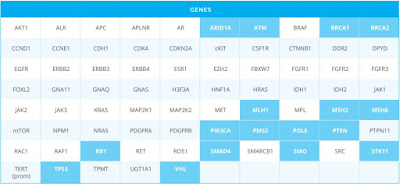


3. Here (https://www.cegat.de/en/diagnostics/tumor-diagnostics/ovarian-cancer/) it is reported that "The detection of a somatic or germline mutation in the BRCA1 or BRCA2 genes is a requirement for treatment with Olaparib (LynparzaTM)"
There are also 4 testing options.
"Option 1: BRCA1 and BRCA2 analysis in tumor tissue only
In option 1, only mutations in the tumor are analyzed, no differentiation between germline and somatic mutations can be made. We do not recommend this option, but will perform it when it is explicitly requested by a patient."
Is it necessary to do such a study to determine the possibility of treatment with Olaparib or is it enough to study Oncodeep (by OncoDNA)? But in Oncodeep only mutations in the tumor are analyzed.
Option 1: BRCA1 and BRCA2 analysis in tumor tissue only
 Option 4: Somatic Tumor Panel

https://www.oncodna.com/en/immunotherapy/
Price: 2990Eur.
Are there any studies predict immune therapy in other laboratories? Is this study useful?


2. By the way, in Moscow (Russia) a study of 50 genes costs $480. Can this research give some useful information? Or these 50 genes is very limited and such information is not sufficient?

3. Here (https://www.cegat.de/en/diagnostics/tumor-diagnostics/ovarian-cancer/) it is reported that "The detection of a somatic or germline mutation in the BRCA1 or BRCA2 genes is a requirement for treatment with Olaparib (LynparzaTM)"
There are also 4 testing options.
"Option 1: BRCA1 and BRCA2 analysis in tumor tissue only
In option 1, only mutations in the tumor are analyzed, no differentiation between germline and somatic mutations can be made. We do not recommend this option, but will perform it when it is explicitly requested by a patient."
Is it necessary to do such a study to determine the possibility of treatment with Olaparib or is it enough to study Oncodeep (by OncoDNA)? But in Oncodeep only mutations in the tumor are analyzed.
Option 1: BRCA1 and BRCA2 analysis in tumor tissue only


Monday, 28 August 2017
Preparing for surgery - tumor analysis & storing
Hello all,
My sister's tumor (AA3) has progressed and a surgery is scheduled.
Would you do tumor analysis and if so, which one:
-Caris Molecular Intelligence
-Foundation One
-OncoDna?
We already know her tumor is IDH1 and TP53 mutated and MGMT methylated. No other mutations we're found last time. Also CD8+, PD1 and PD-L1 were negative. I don't know if there's much to gain this time, because it seems that the number of suitable chemos is anyway quite limited and PD1-inhibitors have shown low efficacy on IDH1mutated tumors?
And do you see benefit to store tumor sample for later use (e.g. Vaccine)?
Br,
Juha
My sister's tumor (AA3) has progressed and a surgery is scheduled.
Would you do tumor analysis and if so, which one:
-Caris Molecular Intelligence
-Foundation One
-OncoDna?
We already know her tumor is IDH1 and TP53 mutated and MGMT methylated. No other mutations we're found last time. Also CD8+, PD1 and PD-L1 were negative. I don't know if there's much to gain this time, because it seems that the number of suitable chemos is anyway quite limited and PD1-inhibitors have shown low efficacy on IDH1mutated tumors?
And do you see benefit to store tumor sample for later use (e.g. Vaccine)?
Br,
Juha
Friday, 10 February 2017
Tom Wangerin - Cocktail Profile and Questions
Hi all,
Although this is my first post, I have been reading every minute of every day. Such an amazing wealth of information on here. I would appreciate any advice on our current course of action and opinions on our cocktail.
My dad was diagnosed with a grade IV GBM. He had surgery on 11/23/16 with 95% resected.
Lab Results:
MGMT Gene Promoter Methylation – Detected.
Percent of MGMT Methylation is 36.19%
IDH1/2 Mutation – Not detected
Positive for 1p Deletion
Currently taking:
· Dexamethasone (Decadron) – He is currently taking 4mg/day but we are doing what we can to wean him off. We have been told this will dictate whether we go on Avastin.
· Eliquis – blood thinner - 5mg twice a day
· Keppra – 500mg twice a day.
· Bactrim (Antibiotic) – Original oncologist prescribed during chemo.
Supplements:
1:1 CBD/THC – Tincture drops in day, Oil at night.
Probiotics – Sibiotica (K-97)
Curcumin - Nutrivene Longvida 1000mg - 1x Morning 1x Night (1000-2000mg daily)
Fish Oil - Vital Nutrients - EPA-720mg, DHA-480mg per cap - 1x Morning
Boswellia Serrata Extract - Progena Meditrend – Currently taking (3) 333mg daily.
Melatonin - Vital Nutrients - 10mg/cap - 1x at Night (eventually will do 20mg)
Mushroom Extracts - Turkey Tail (Coriolus), Maitake D-faction, and Reishi each once a day.
Berberine - Vital Nutrients - 200mg/cap – starting with 1x day, soon 3/day.
Debating whether to add - Resveratrol and Green Tea Extract
Our NO was okay with all and suggested adding Cronaxal. I’ve struggled to find much convincing information out there, but I do trust our NO. Now the question is to use Cronaxal (expensive and high dosage) or get Sulfasalim (which Stephen ranked pretty high on his spreadsheet).
I read that this can benefit those that are NOT IDH mutated (which is us).
Genetic Testing
We are getting the tumor tested from Foundation One for more details – once we make sure there is enough tumor for them to test, and have some left for potential clinical trials. I’m keeping an eye out for EGFR, p53, VDR, HIF-1.
Any thoughts here?
Hoping for some advice in a selection of the following:
**Vitamin D3 – In some cases Vitamin D3 caused proliferation in some patients (Stephen W speaks of this: http://astrocytomaoptions.com/supplements/). Our NO was okay w/ Vitamin D3. Would checking his VDR receptor be of value for determining this, or is it safe (and potentially beneficial) to take 5,000-10,000iu daily regardless of tumor type?
I was very excited about a few of the prescription drugs below, but our NO was certain that none of them get past the blood brain barrier while taking doses safe for humans. We are still willing to give a few of them a shot, but I’m struggling to decide which combinations.
· **Chloroquine Phosphate – (if overexpressing the EGFR protein or p53 status is unmutated) & **DCA - Sodium Dichloroacetate –(if HIF-1 is expressing) http://astrocytomaoptions.com/targeting-tumour-metabolism/
· **Disulfiram – This drug looks like it has amazing potential.
http://www.impactjournals.com/oncotarget/index.php?journal=oncotarget&page=article&op=view&path%5B%5D=707
· **Sildenafil & Celebrex: can work synergistically for both getting past blood brain barrier, anti-tumor qualities, and Celebrex potentially helping with a bit of edema.
http://onlinelibrary.wiley.com/doi/10.1002/jcp.24843/abstract
· VT-122 (Etodolac & Propranolol) – with low dose daily TMZ schedule. This had great results. Any reason why more people aren’t doing this themselves?
(http://meetinglibrary.asco.org/content/151704-156)
· CUSP9 – Looks like an amazing plan. I am yet to read of any results but I know many are starting to replicate this cocktail on their own.
http://www.impactjournals.com/oncotarget/index.php?journal=oncotarget&page=article&op=view&path[]=2408
Current Plan:
I. TMZ Schedule – Because he is MGMT methylated it was an easy decision to go forward with the monthly TMZ cycles. All of our docs have insisted on the high dose 5days/month schedule rather than a metronomic schedule, regardless of whether EGFR is over expressed. Thoughts?
https://academic.oup.com/jnci/article/107/5/djv041/891259/EGFR-Amplified-and-Overexpressing-Glioblastomas
II. Optune Machine – The UCSF board feels it’s not as beneficial as some of the studies make it out to be, and with it being such a pain to wear for the rest of your life… it’s not that easy of decision even with insurance coverage. I’m undecided here.
III. Prescriptions with TMZ/Avastin - If you had to pick one prescription duo to take with TMZ and one prescription duo to take with Avastin to make them more effective which would you pick?
Thank you all for pitching in. This journey has been life changing, but manageable with the help you all bring.
Although this is my first post, I have been reading every minute of every day. Such an amazing wealth of information on here. I would appreciate any advice on our current course of action and opinions on our cocktail.
My dad was diagnosed with a grade IV GBM. He had surgery on 11/23/16 with 95% resected.
Lab Results:
MGMT Gene Promoter Methylation – Detected.
Percent of MGMT Methylation is 36.19%
IDH1/2 Mutation – Not detected
Positive for 1p Deletion
- Completed his first round of daily chemo/radiation on 1/19/17.
- Our first image was taken on 2/3/17. We had our first consultation with the UCSF Tumor Board (Dr. Butowski) on 2/7/17.
- Tumor had not seemed to grow in size any, but did morph into a new shape/area which is scary to see. Next image in 2 months.
Currently taking:
· Dexamethasone (Decadron) – He is currently taking 4mg/day but we are doing what we can to wean him off. We have been told this will dictate whether we go on Avastin.
· Eliquis – blood thinner - 5mg twice a day
· Keppra – 500mg twice a day.
· Bactrim (Antibiotic) – Original oncologist prescribed during chemo.
Supplements:
1:1 CBD/THC – Tincture drops in day, Oil at night.
Probiotics – Sibiotica (K-97)
Curcumin - Nutrivene Longvida 1000mg - 1x Morning 1x Night (1000-2000mg daily)
Fish Oil - Vital Nutrients - EPA-720mg, DHA-480mg per cap - 1x Morning
Boswellia Serrata Extract - Progena Meditrend – Currently taking (3) 333mg daily.
Melatonin - Vital Nutrients - 10mg/cap - 1x at Night (eventually will do 20mg)
Mushroom Extracts - Turkey Tail (Coriolus), Maitake D-faction, and Reishi each once a day.
Berberine - Vital Nutrients - 200mg/cap – starting with 1x day, soon 3/day.
Debating whether to add - Resveratrol and Green Tea Extract
Our NO was okay with all and suggested adding Cronaxal. I’ve struggled to find much convincing information out there, but I do trust our NO. Now the question is to use Cronaxal (expensive and high dosage) or get Sulfasalim (which Stephen ranked pretty high on his spreadsheet).
I read that this can benefit those that are NOT IDH mutated (which is us).
Genetic Testing
We are getting the tumor tested from Foundation One for more details – once we make sure there is enough tumor for them to test, and have some left for potential clinical trials. I’m keeping an eye out for EGFR, p53, VDR, HIF-1.
Any thoughts here?
Hoping for some advice in a selection of the following:
**Vitamin D3 – In some cases Vitamin D3 caused proliferation in some patients (Stephen W speaks of this: http://astrocytomaoptions.com/supplements/). Our NO was okay w/ Vitamin D3. Would checking his VDR receptor be of value for determining this, or is it safe (and potentially beneficial) to take 5,000-10,000iu daily regardless of tumor type?
I was very excited about a few of the prescription drugs below, but our NO was certain that none of them get past the blood brain barrier while taking doses safe for humans. We are still willing to give a few of them a shot, but I’m struggling to decide which combinations.
· **Chloroquine Phosphate – (if overexpressing the EGFR protein or p53 status is unmutated) & **DCA - Sodium Dichloroacetate –(if HIF-1 is expressing) http://astrocytomaoptions.com/targeting-tumour-metabolism/
· **Disulfiram – This drug looks like it has amazing potential.
http://www.impactjournals.com/oncotarget/index.php?journal=oncotarget&page=article&op=view&path%5B%5D=707
· **Sildenafil & Celebrex: can work synergistically for both getting past blood brain barrier, anti-tumor qualities, and Celebrex potentially helping with a bit of edema.
http://onlinelibrary.wiley.com/doi/10.1002/jcp.24843/abstract
· VT-122 (Etodolac & Propranolol) – with low dose daily TMZ schedule. This had great results. Any reason why more people aren’t doing this themselves?
(http://meetinglibrary.asco.org/content/151704-156)
· CUSP9 – Looks like an amazing plan. I am yet to read of any results but I know many are starting to replicate this cocktail on their own.
http://www.impactjournals.com/oncotarget/index.php?journal=oncotarget&page=article&op=view&path[]=2408
Current Plan:
I. TMZ Schedule – Because he is MGMT methylated it was an easy decision to go forward with the monthly TMZ cycles. All of our docs have insisted on the high dose 5days/month schedule rather than a metronomic schedule, regardless of whether EGFR is over expressed. Thoughts?
https://academic.oup.com/jnci/article/107/5/djv041/891259/EGFR-Amplified-and-Overexpressing-Glioblastomas
II. Optune Machine – The UCSF board feels it’s not as beneficial as some of the studies make it out to be, and with it being such a pain to wear for the rest of your life… it’s not that easy of decision even with insurance coverage. I’m undecided here.
III. Prescriptions with TMZ/Avastin - If you had to pick one prescription duo to take with TMZ and one prescription duo to take with Avastin to make them more effective which would you pick?
Thank you all for pitching in. This journey has been life changing, but manageable with the help you all bring.
Friday, 25 November 2016
FoundationOne test now includes "Tumor Mutational Burden" quantification
To my surprise, I just learned that FoundationOne reports now include a quantification of "tumor mutational burden" expressed as number of mutations per megabase of DNA. This would be the most accurate test for hypermutation.
Foundation One webpage
I believe there is a link between MGMT methylation status, and risk of hypermutated recurrence, which could help explain the increased risk of progression to hypermutated secondary GBM recurrences for IDH1-mutant low grade gliomas (which are usually MGMT methylated) treated with TMZ.
I'd especially recommend FoundationOne for recurrences of MGMT methylated gliomas post-TMZ treatment. This test would tell you if the tumor is hypermutated and therefore if further TMZ could actually make the situation worse. Unfortunately patients outside the US must self-pay, and the discounted price as of September 2014 was $4600 US.
Foundation One webpage
I believe there is a link between MGMT methylation status, and risk of hypermutated recurrence, which could help explain the increased risk of progression to hypermutated secondary GBM recurrences for IDH1-mutant low grade gliomas (which are usually MGMT methylated) treated with TMZ.
I'd especially recommend FoundationOne for recurrences of MGMT methylated gliomas post-TMZ treatment. This test would tell you if the tumor is hypermutated and therefore if further TMZ could actually make the situation worse. Unfortunately patients outside the US must self-pay, and the discounted price as of September 2014 was $4600 US.
Friday, 20 November 2015
Which mutations to test for?
Hello guys!
I have surgery of my low grade glioma scheduled in less than 2 weeks, but the neurosurgeon told me they don't test for many mutations/markers unless I specifically ask them to.
At the moment I know of:
-IDH1/IDH2
-1p/19q
-MGMT methylation
-EGFR vIII
Is there any other mutation/marker I should ask them to test?
Your help is greatly appreciated,
Matjaz
I have surgery of my low grade glioma scheduled in less than 2 weeks, but the neurosurgeon told me they don't test for many mutations/markers unless I specifically ask them to.
At the moment I know of:
-IDH1/IDH2
-1p/19q
-MGMT methylation
-EGFR vIII
Is there any other mutation/marker I should ask them to test?
Your help is greatly appreciated,
Matjaz
Sunday, 8 November 2015
CARIS report
Hi,
This is part of the CARIS report of my brothers tumour. We are looking into further drugs for him to take. Can anyone offer any advice from this information? I have 12 pages of results but unfortunately the Dr hasn't offered any advice!Thanks, Lisa
PAGE 2 of 12
Biomarker
|
Method
|
Result
|
EGFR
|
IHC
|
Positive
|
MGMT
|
Pyro SEQ
|
Methylated
|
PD-1 IHC
|
IHC
|
Positive
|
RRM1
|
IHC
|
Negative
|
Biomarker
|
Method
|
Result
|
TLE3
|
IHC
|
Positive
|
TOPO1
|
IHC
|
Positive
|
TS
|
IHC
|
Negative
|
Sunday, 30 August 2015
Accutane.. online? How to get in US
Hi, new here. My father was just diagnosed with GBM stage 4 on Tuesday. He's 63. I've started him on many of the Ben W drugs. Chemo can't start for another week + while biopsy heals.
I need help sourcing Accutane. Has anyone bought online or from Mexico? Were in the US and even if I get some myself the I Pledge will slow me down. I feel its an urgent component to his care and would like to start it now as we're pre-chemo. Contemplating a trip to Tijuana next. If anyone has advice there also welcomed.
Thanks.
Annie
I need help sourcing Accutane. Has anyone bought online or from Mexico? Were in the US and even if I get some myself the I Pledge will slow me down. I feel its an urgent component to his care and would like to start it now as we're pre-chemo. Contemplating a trip to Tijuana next. If anyone has advice there also welcomed.
Thanks.
Annie
Subscribe to:
Posts (Atom)